

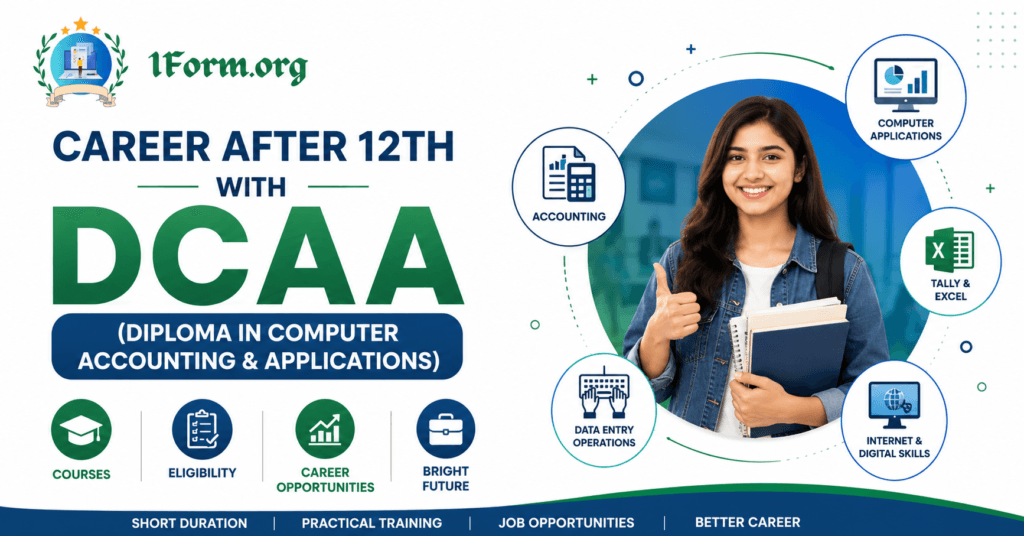
Choosing the right career after Class 12 is an important decision for students who want to build a successful professional future. For students interested in accounting, computers, finance, taxation, business, and office applications, DCAA (Diploma in Computer Accounting & Applications) can be a practical career-oriented option.
Today, almost every business uses computers and digital accounting systems to manage financial transactions, invoices, payroll, taxation, inventory, and business records. As a result, employers need professionals who understand both accounting concepts and computer applications.
A DCAA course is generally designed to provide practical knowledge of financial accounting, computerized accounting, Tally, GST, MS Office, Excel, taxation, payroll, and business applications. It can help students develop job-ready skills and prepare for entry-level opportunities in accounting and administrative roles.
Apply Now-
What is DCAA (Diploma in Computer Accounting & Applications)?
DCAA stands for Diploma in Computer Accounting & Applications. It is a professional diploma program that combines accounting knowledge with computer-based applications.
The course is particularly useful for students who want to learn how traditional accounting practices are performed using modern digital tools and software.
Depending on the institute, the curriculum may include:
- Financial Accounting
- Computerized Accounting
- Tally Prime
- GST
- Income Tax Basics
- Microsoft Excel
- Microsoft Word
- PowerPoint
- Payroll Management
- Inventory Management
- Banking Transactions
- Business Communication
- Computer Fundamentals
The exact syllabus and duration can differ from one institute to another, so students should check the official course structure before taking admission.
Why Choose DCAA After 12th?
DCAA can be a good choice for students who want to develop practical accounting and computer skills without immediately committing to a long professional degree.
Major Benefits of DCAA
- Combines accounting and computer skills
- Practical and job-oriented learning
- Suitable for students from different streams
- Helps develop knowledge of computerized accounting
- Useful for entry-level finance and office jobs
- Can be completed in a relatively short duration
- Provides a foundation for higher studies
- Opportunities for freelancing and independent accounting work
- Useful across multiple industries
The combination of accounting knowledge and computer proficiency can be particularly valuable for small businesses, accounting firms, offices, startups, and companies that rely on digital financial systems.
DCAA Course Highlights
| Particular | Details |
|---|---|
| Course Name | Diploma in Computer Accounting & Applications |
| Common Abbreviation | DCAA |
| Course Level | Diploma |
| Duration | Generally 6 Months to 1 Year |
| Eligibility | Usually Class 12 Pass |
| Streams | Arts, Commerce, Science, depending on institute |
| Admission | Merit-Based or Direct Admission |
| Course Mode | Regular/Online, depending on institute |
| Main Areas | Accounting, Taxation, Computer Applications |
| Career Fields | Accounting, Finance, Administration, Office Management |
The duration, eligibility, and admission requirements can vary among colleges and training institutes.
Eligibility for DCAA After 12th
Students who have completed Class 12 from a recognized board can generally apply for DCAA programs.
| Eligibility Criteria | General Requirement |
|---|---|
| Educational Qualification | Class 12 or equivalent |
| Stream | Arts, Commerce, or Science |
| Minimum Marks | As prescribed by the institute |
| Age Limit | Usually no specific age limit |
| Computer Knowledge | Basic computer knowledge may be helpful |
Commerce students may have an advantage because they may already be familiar with basic accounting concepts. However, students from Arts and Science backgrounds can also pursue the course if they have an interest in accounting and computers.
DCAA Admission Process
The admission process for DCAA is generally simple. However, it depends on the institute offering the course.
Step 1: Research Institutes
Compare institutes based on course curriculum, faculty, practical training, fees, and certification.
Step 2: Check Eligibility
Make sure you meet the institute’s educational requirements.
Step 3: Fill the Application Form
Complete the online or offline application process.
Step 4: Submit Documents
Common documents may include:
- Class 10 certificate
- Class 12 certificate
- Passport-size photographs
- Identity proof
- Address proof
Step 5: Admission Confirmation
After completing the admission formalities and paying the required fee, students can begin the course.
Many private training institutes provide direct admission, while some institutions may select students based on merit.
DCAA Course Syllabus and Subjects
The syllabus is usually focused on practical accounting and computer applications.
| Subject | Key Topics |
|---|---|
| Financial Accounting | Journal, Ledger, Trial Balance |
| Computerized Accounting | Digital Accounting Systems |
| Tally Prime | Accounting Transactions and Reports |
| GST | GST Concepts and Compliance Basics |
| Income Tax | Basic Taxation Concepts |
| MS Excel | Formulas, Tables, Financial Data |
| MS Word | Document Preparation |
| PowerPoint | Presentations |
| Payroll Accounting | Salary and Employee Records |
| Inventory Management | Stock and Purchase Records |
| Banking | Bank Transactions and Reconciliation |
| Business Communication | Workplace Communication |
The syllabus may also include practical assignments and computer lab sessions.
Computer Applications You Can Learn in DCAA
One of the main benefits of DCAA is its focus on practical computer applications.
Students may learn:
- Tally Prime
- Microsoft Excel
- Microsoft Word
- Microsoft PowerPoint
- Basic accounting software
- GST-related online processes
- Digital documentation
- Data management
- Internet applications
MS Excel is particularly useful for accounting professionals because it can be used for financial calculations, reports, data organisation, and analysis.
Apply Now-
Skills Developed Through DCAA
A DCAA course can help students develop a combination of accounting and technical skills.
Accounting Skills
- Bookkeeping
- Journal Entries
- Ledger Preparation
- Trial Balance
- Bank Reconciliation
- Financial Statements
- Invoice Management
- Basic Taxation
Computer Skills
- Tally
- MS Excel
- MS Word
- PowerPoint
- Data Entry
- Digital Record Management
Professional Skills
- Communication
- Time Management
- Attention to Detail
- Analytical Thinking
- Problem Solving
- Office Management
Career Opportunities After DCAA
After completing DCAA, students can explore various entry-level roles in accounting, finance, and office administration.
| Job Profile | Work Responsibilities |
|---|---|
| Junior Accountant | Maintains basic financial records |
| Accounts Assistant | Supports accounting department |
| Computer Operator | Handles computer-based office tasks |
| Tally Operator | Manages accounting entries using Tally |
| Billing Executive | Prepares invoices and manages billing |
| Accounts Executive | Handles day-to-day accounting activities |
| GST Assistant | Supports GST-related documentation |
| Payroll Assistant | Helps manage salary records |
| Data Entry Executive | Maintains digital records |
| Office Assistant | Performs administrative and computer tasks |
Job responsibilities and titles can vary depending on the employer and level of experience.
Where Can DCAA Professionals Work?
DCAA-qualified candidates can explore opportunities across multiple industries.
Potential employment sectors include:
- Chartered Accountant firms
- Accounting firms
- Manufacturing companies
- Retail businesses
- E-commerce companies
- Hospitals
- Schools and colleges
- Banks and financial service companies
- Logistics companies
- Real estate firms
- Startups
- Small and medium-sized businesses
Since accounting is required by almost every organisation, the skills gained through DCAA can be applied across different sectors.
Salary After DCAA in India
The salary after DCAA depends on factors such as experience, location, company, job profile, and technical skills.
| Experience | Approximate Annual Salary |
|---|---|
| Fresher | ₹2–3.5 LPA |
| 1–3 Years | ₹3–5 LPA |
| 3–5 Years | ₹4.5–7 LPA |
| Experienced Professional | ₹6–10+ LPA |
These figures are indicative and actual salaries can vary. Candidates with additional skills in GST, Advanced Excel, SAP, ERP systems, taxation, and financial analysis may have better career opportunities.
Higher Education After DCAA
DCAA does not have to be the end of your education. Students can use the skills gained through the diploma as a foundation for higher studies.
Possible options include:
| Course | Career Direction |
|---|---|
| B.Com | Accounting and Commerce |
| BBA | Business Management |
| BCA | Computer Applications |
| B.Voc | Skill-Based Professional Education |
| MBA Finance | Finance and Management |
| M.Com | Advanced Commerce |
| CA | Professional Accounting |
| CMA | Cost and Management Accounting |
| ACCA | Global Accounting Career |
Students should check the specific eligibility requirements for each higher education program.
DCAA vs DFA: Which Course Is Better?
Both DCAA and DFA (Diploma in Financial Accounting) are useful for students interested in accounting, but their focus can differ.
| Feature | DCAA | DFA |
|---|---|---|
| Full Form | Diploma in Computer Accounting & Applications | Diploma in Financial Accounting |
| Main Focus | Accounting + Computer Applications | Financial Accounting |
| Computer Training | Strong Focus | Usually Included |
| Tally | Commonly Covered | Commonly Covered |
| MS Office | Often Included | May Be Included |
| GST | Generally Covered | Generally Covered |
| Suitable For | Accounting + Computer Skills | Accounting-Focused Careers |
The best option depends on your career goals. If you want a combination of accounting and computer applications, DCAA may be a suitable choice. If your primary interest is financial accounting, a DFA program may be more focused.
Future Scope of DCAA
The future scope of computer accounting is closely linked to the digital transformation of businesses. Companies are increasingly adopting accounting software, cloud-based systems, digital payments, online taxation, and automated financial reporting.
DCAA graduates can improve their career prospects by learning additional technologies and skills such as:
- Advanced Excel
- SAP
- ERP Software
- Power BI
- Cloud Accounting
- Financial Data Analysis
- GST Compliance
- Taxation
- Payroll Software
Professionals who combine accounting knowledge with data and technology skills can explore more specialised career opportunities.
How to Build a Successful Career After DCAA
Completing the diploma is only the first step. Students should focus on gaining practical experience and continuously improving their skills.
Follow These Career Tips:
- Master Tally Prime and accounting fundamentals.
- Learn Advanced Excel.
- Understand GST and basic taxation.
- Complete internships with accounting firms or businesses.
- Improve communication skills.
- Learn how to prepare professional financial reports.
- Gain practical experience with real accounting transactions.
- Consider additional certifications.
- Keep yourself updated with accounting technology.
- Build a strong resume highlighting technical skills.
Practical experience can make a significant difference when applying for entry-level jobs.
Apply Now-
Can DCAA Students Work as Freelancers?
Yes, students with strong accounting and software skills may explore independent work opportunities. Small businesses often need assistance with bookkeeping, invoicing, data management, and basic accounting tasks.
However, students should understand the applicable legal and professional requirements before independently offering tax or compliance-related services. For specialised financial or tax advice, working under qualified professionals may be appropriate.