
Career After 12th
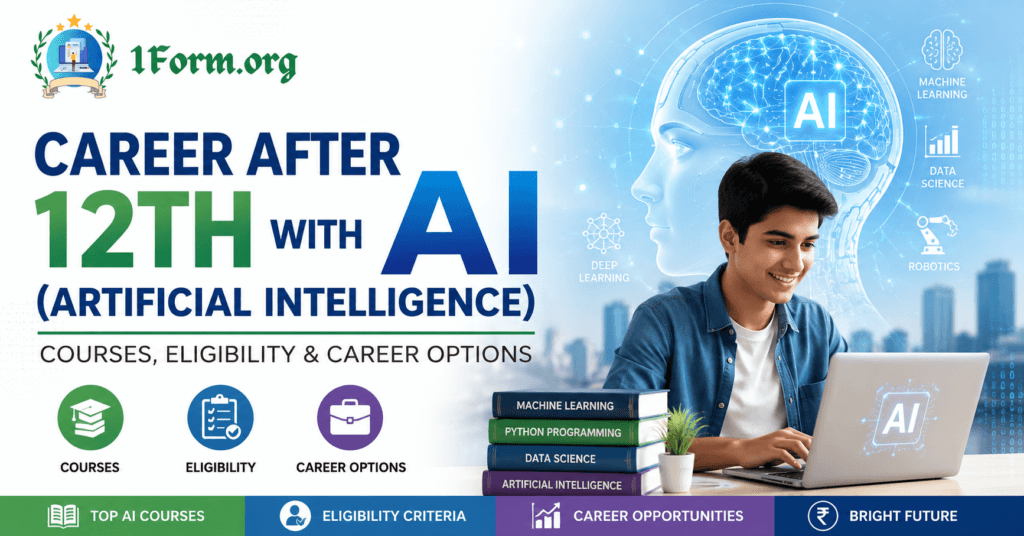
Artificial Intelligence (AI) is rapidly becoming one of the most important technologies across industries. From healthcare and banking to e-commerce, automobiles, education and cybersecurity, organisations are using AI to automate tasks, analyse data and build intelligent applications. Because of this growth, students completing Class 12 can consider several AI career options after 12th.
Students do not necessarily need to become AI engineers immediately after school. They can choose undergraduate courses in Artificial Intelligence, Machine Learning, Computer Science, Data Science, Computer Applications, Robotics or related fields, depending on their interests and academic background.
Apply Now-
AI Career After 12th
| Particular | Details |
|---|---|
| Career Field | Artificial Intelligence |
| Suitable Streams | Mainly Science with PCM/Computer Science; other routes also exist |
| Popular UG Courses | B.Tech AI/ML, B.Tech CSE, B.Sc AI, BCA, Data Science |
| Course Duration | Generally 3–4 Years |
| Entrance Exams | JEE Main, CUET and university-specific exams, depending on course |
| Important Skills | Programming, Mathematics, Statistics, Data Analysis |
| Popular Technologies | Python, Machine Learning, Generative AI, Deep Learning |
| Job Areas | AI, Software, Data, Automation, Robotics |
| Higher Studies | M.Tech, M.Sc, MBA, PhD and specialised certifications |
What is Artificial Intelligence?
Artificial Intelligence is a field of technology that enables computer systems to perform tasks that normally require human-like intelligence.
AI systems can be designed to:
- Understand language
- Recognise images
- Analyse data
- Make predictions
- Generate content
- Identify patterns
- Automate processes
- Support decision-making
Some major AI areas include Machine Learning, Deep Learning, Natural Language Processing, Computer Vision, Generative AI and Robotics.
Why Choose an AI Career After 12th?
AI is becoming part of many modern industries. Students who start learning AI-related skills early can build a strong technical foundation during their undergraduate studies.
Major Advantages
- Growing technology sector
- Multiple career paths
- Opportunities across industries
- Scope for remote and global jobs
- Strong connection with data science and software development
- Opportunities for research and innovation
- Entrepreneurship opportunities
- Application in emerging technologies
However, AI is a technical field. Students should be prepared to learn mathematics, programming, statistics and problem-solving.
Best AI Courses After 12th
There is no single course that is compulsory for an AI career. Students can choose different academic routes.
| Course | Duration | Suitable For |
|---|---|---|
| B.Tech Artificial Intelligence | 4 Years | Students interested in engineering & AI |
| B.Tech AI & Machine Learning | 4 Years | AI/ML-focused careers |
| B.Tech CSE with AI/ML | 4 Years | Computer Science + AI |
| B.Sc Artificial Intelligence | 3–4 Years | Science-oriented students |
| B.Sc Data Science | 3–4 Years | Data & analytics |
| BCA | 3–4 Years | Computer applications |
| BCA with AI/Data Science | 3–4 Years | Applications + AI |
| B.Sc Computer Science | 3–4 Years | Programming & computing |
| Diploma in AI | Varies | Skill-focused learning |
The duration can vary according to the university’s curriculum structure.
1. B.Tech Artificial Intelligence
B.Tech in Artificial Intelligence is one of the most direct undergraduate routes for students who want to work in AI.
The course generally covers:
- Programming
- Data Structures
- Algorithms
- Mathematics
- Statistics
- Machine Learning
- Deep Learning
- Computer Vision
- Natural Language Processing
- AI applications
Possible Careers
- AI Engineer
- Machine Learning Engineer
- AI Developer
- Computer Vision Engineer
- NLP Engineer
- Data Scientist
2. B.Tech AI & Machine Learning
Students who specifically want to focus on machine learning can consider B.Tech Artificial Intelligence and Machine Learning.
The curriculum typically combines computer science fundamentals with advanced AI concepts.
Students may learn:
- Python
- Machine Learning
- Neural Networks
- Deep Learning
- Data Analytics
- Computer Vision
- Natural Language Processing
- AI Model Development
This can be a good choice for students who are comfortable with mathematics and programming.
3. B.Tech Computer Science with AI/ML
Another strong pathway is B.Tech Computer Science Engineering with an AI/ML specialisation.
The advantage is that students learn core computer science along with AI.
| Core CSE | AI/ML |
|---|---|
| Programming | Machine Learning |
| Data Structures | Deep Learning |
| Algorithms | Neural Networks |
| Operating Systems | Computer Vision |
| Database Systems | NLP |
| Computer Networks | AI Applications |
This combination can provide flexibility if a student later decides to work in general software development rather than AI.
4. B.Sc Artificial Intelligence
Students looking for a science-oriented undergraduate program can explore B.Sc Artificial Intelligence.
Depending on the university, the curriculum may include:
- Programming
- Mathematics
- Statistics
- Machine Learning
- Data Science
- AI fundamentals
- Database concepts
- AI applications
Students should compare the syllabus and practical training before choosing a B.Sc AI program.
5. BCA with AI and Data Science
BCA can also be a pathway into AI, especially when combined with specialised courses in:
- Artificial Intelligence
- Machine Learning
- Data Analytics
- Cloud Computing
- Python
- Database Management
Students can later pursue MCA, M.Sc, specialised certifications or other advanced programs.
AI Eligibility After 12th
Eligibility depends on the selected course and university.
General Requirements for B.Tech AI
Students generally need:
- Class 12 qualification
- Physics and Mathematics as required subjects
- Chemistry/Biotechnology/Computer Science or another prescribed subject
- Required minimum marks
- Entrance examination qualification where applicable
For B.Sc/BCA AI Programs
Eligibility can vary considerably. Some programs accept students from different streams, while others may require Mathematics or Computer Science.
| Course | Common Eligibility |
|---|---|
| B.Tech AI | 10+2 with required PCM subjects |
| B.Tech CSE AI/ML | 10+2 with prescribed engineering subjects |
| B.Sc AI | 10+2, often Science preferred/required |
| BCA AI | 10+2, university-specific |
| B.Sc Data Science | 10+2, often Mathematics required |
| Diploma in AI | 10+2 as prescribed by institute |
Always check the specific university’s eligibility criteria before applying.
AI Entrance Exams After 12th
Students may need to qualify for an entrance examination depending on the course and institution.
Popular admission routes can include:
- JEE Main for participating engineering institutions
- CUET UG for participating universities/programs
- State-level engineering entrance processes where applicable
- University-specific entrance examinations
- Merit-based admission for selected programs
Entrance requirements are different for every institution, so students should check the current admission notification.
AI Course Syllabus
An AI degree combines computer science, mathematics and specialised AI subjects.
Common AI Subjects
| Subject | Purpose |
|---|---|
| Python Programming | AI programming |
| Data Structures | Efficient data processing |
| Mathematics | Mathematical foundation |
| Statistics | Data analysis |
| Machine Learning | Predictive models |
| Deep Learning | Neural network applications |
| NLP | Language-based AI |
| Computer Vision | Image/video intelligence |
| Database Management | Data storage |
| Cloud Computing | Scalable AI systems |
| Generative AI | AI-generated content |
| AI Ethics | Responsible AI development |
Skills Required for an AI Career
A successful AI professional needs more than a degree.
Technical Skills
Students should consider learning:
- Python
- SQL
- Statistics
- Linear Algebra
- Machine Learning
- Data Structures
- Git
- Data Visualisation
- Deep Learning
Emerging AI Skills
Modern students can also explore:
- Generative AI
- Large Language Models
- Prompt Engineering
- Retrieval-Augmented Generation
- AI Agents
- Computer Vision
- Natural Language Processing
The technology changes rapidly, so continuous learning is important.
Career Options After 12th with AI
After completing an appropriate undergraduate program and developing relevant skills, students can explore several career paths.
| Career | Main Work |
|---|---|
| AI Engineer | Develop AI-based systems |
| Machine Learning Engineer | Build and deploy ML models |
| Data Scientist | Analyse data and develop models |
| Data Analyst | Analyse business data |
| AI Developer | Develop AI applications |
| NLP Engineer | Work on language technologies |
| Computer Vision Engineer | Build image/video AI systems |
| Robotics Engineer | Develop intelligent robotic systems |
| AI Researcher | Research new AI methods |
| Business Intelligence Analyst | Convert data into business insights |
Salary After AI Courses
Salary depends on education, technical skills, experience, employer and location.
| Career | Approx. Fresher Range |
|---|---|
| AI/ML Engineer | ₹4–8 LPA |
| Data Analyst | ₹3–6 LPA |
| Software Developer | ₹3–7 LPA |
| Data Scientist | ₹4–9 LPA |
| AI Developer | ₹4–8 LPA |
| Business Analyst | ₹4–8 LPA |
These are broad indicative ranges rather than guaranteed salaries. Strong skills, internships and projects can improve employment opportunities.
Apply Now-
AI Career Scope in India
AI is being adopted across numerous industries.
Healthcare
AI can support:
- Medical image analysis
- Healthcare analytics
- Drug discovery
- Patient data analysis
Banking and Finance
Applications include:
- Fraud detection
- Risk analysis
- Credit assessment
- Customer support
E-Commerce
AI is used for:
- Product recommendations
- Search optimisation
- Customer behaviour analysis
- Chatbots
Manufacturing
AI can support:
- Predictive maintenance
- Quality inspection
- Automation
- Robotics
Education
AI applications include:
- Personalised learning
- Automated assessments
- Educational assistants
- Learning analytics
AI vs Computer Science – Which is Better?
Students often ask whether they should choose AI or traditional CSE.
| Factor | AI/ML Specialisation | CSE |
|---|---|---|
| Focus | AI & Machine Learning | Broad Computing |
| Programming | High | High |
| Mathematics | High | Moderate–High |
| AI Exposure | Strong | Depends on curriculum |
| Software Career | Possible | Strong |
| Flexibility | Specialised | Broad |
| Research Scope | Strong | Strong |
For students who are already confident about AI, an AI/ML specialisation can be attractive. Students who want broader computing options may prefer B.Tech CSE and later specialise in AI.
Higher Studies After AI Graduation
After completing an AI-related bachelor’s degree, students can pursue:
- M.Tech Artificial Intelligence
- M.Tech Computer Science
- M.Sc Artificial Intelligence
- M.Sc Data Science
- MCA
- MBA in Business Analytics
- PhD in AI/Computer Science
- Professional AI certifications
Higher education can be particularly useful for students interested in research, specialised technical roles or academia.
How to Start Learning AI After 12th?
Students don’t have to wait until college to begin learning.
Step 1: Learn Python
Start with basic programming concepts.
Step 2: Improve Mathematics
Focus on:
- Probability
- Statistics
- Linear algebra
- Basic calculus
Step 3: Learn Data Handling
Understand spreadsheets, SQL and basic data analysis.
Step 4: Build Machine Learning Knowledge
Learn concepts such as:
- Regression
- Classification
- Clustering
- Model evaluation
Step 5: Build Projects
Create small projects such as:
- Chatbot
- Recommendation system
- Image classifier
- Sentiment analysis project
- Predictive analytics dashboard
Projects can help demonstrate practical skills to future employers.
Is AI a Good Career After 12th?
Yes, AI can be an excellent career field for students who enjoy technology, mathematics, programming, problem-solving and experimentation.
However, students should not choose AI only because it is a trending field. AI requires continuous learning and technical practice. Students should select a course whose curriculum provides strong fundamentals in computer science, mathematics, programming and data.