
Career After 12th
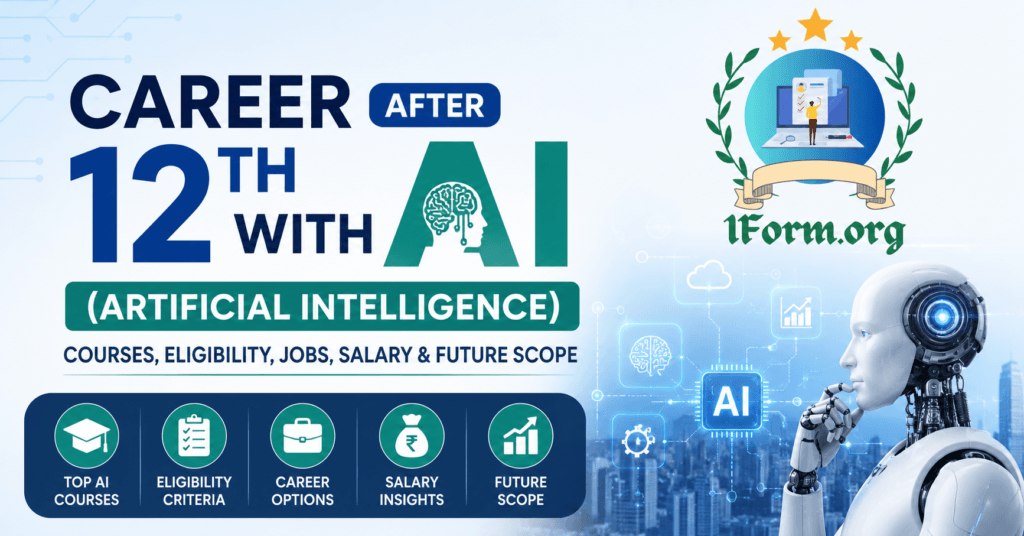
Artificial Intelligence (AI) is rapidly changing the way businesses, industries, education, healthcare, finance and technology work. For students who have completed Class 12, AI has become one of the most promising career fields with opportunities in software development, data science, machine learning, robotics, automation and research.
If you are searching for career after 12th with AI, AI courses after 12th, Artificial Intelligence courses after 12th, or best career options in AI, this guide will help you understand the available courses, eligibility, entrance exams, skills, career opportunities and future scope.
Unlike traditional career paths, Artificial Intelligence offers students the opportunity to combine programming, mathematics, statistics and problem-solving skills to build intelligent systems. With the growing demand for AI professionals, choosing the right course after 12th can be an important step toward a successful technology career.
Apply Now-
Why Choose Artificial Intelligence as a Career After 12th?
AI is becoming an important part of modern industries. Companies are using AI for customer service, fraud detection, medical diagnosis, recommendation systems, autonomous technologies and business analytics. This has increased the demand for professionals who understand AI technologies.
Students interested in Artificial Intelligence after 12th can choose undergraduate degrees, diploma programs, certifications or specialized online courses. The best option depends on the student’s academic background and career goals.
Some major reasons to consider an AI career include:
- Growing demand for AI and machine learning professionals
- Opportunities in technology and non-technology industries
- High potential for career growth
- Scope for innovation and research
- Opportunities to work in India and abroad
- Multiple career paths in AI, ML, data science and robotics
Best AI Courses After 12th
Students can select from several undergraduate courses related to Artificial Intelligence. The most popular options are B.Tech and B.Sc. programs, while BCA and other technology degrees can also provide a foundation for AI-related careers.
| Course | Duration | Suitable For |
|---|---|---|
| B.Tech in Artificial Intelligence | 4 Years | Students interested in engineering and AI |
| B.Tech in AI & Machine Learning | 4 Years | Students interested in ML and intelligent systems |
| B.Tech in Computer Science with AI | 4 Years | Students wanting a broad computer science foundation |
| B.Sc. Artificial Intelligence | 3 Years | Students interested in AI, data and computing |
| B.Sc. Data Science | 3 Years | Students interested in data analytics and AI |
| BCA with AI/ML Specialization | 3 Years | Students interested in software and applications |
| Diploma in AI & Machine Learning | Varies | Students seeking skill-based learning |
| Certificate Courses in AI | Short Term | Beginners and students seeking additional skills |
Course names, duration and eligibility requirements may differ between universities and institutions. Students should always check the latest admission notification before applying.
B.Tech in Artificial Intelligence After 12th
B.Tech Artificial Intelligence is one of the most popular choices for students who want to build a professional career in AI. The course generally covers programming, mathematics, machine learning, deep learning, data structures, algorithms, computer networks and AI applications.
Students may learn subjects such as:
- Programming fundamentals
- Data Structures and Algorithms
- Database Management Systems
- Artificial Intelligence
- Machine Learning
- Deep Learning
- Natural Language Processing
- Computer Vision
- Data Science
- Robotics
- Cloud Computing
After completing a B.Tech in AI, graduates can apply for roles such as AI Engineer, Machine Learning Engineer, Data Scientist and Computer Vision Engineer.
Eligibility for AI Courses After 12th
Eligibility depends on the course and university. Generally, students applying for B.Tech programs need to complete Class 12 with Physics and Mathematics, along with the required third subject as specified by the institution.
For B.Sc. and BCA programs, eligibility requirements may be different.
| Program | General Eligibility |
|---|---|
| B.Tech AI | Class 12 with required science subjects, generally including Mathematics |
| B.Tech AI & ML | Class 12 with Physics and Mathematics as required by the institute |
| B.Sc. AI | Class 12; subject requirements vary by university |
| B.Sc. Data Science | Class 12; Mathematics may be required or preferred |
| BCA AI/ML | Class 12 from a recognized board; requirements vary |
| Diploma in AI | Class 12 or equivalent, depending on the institute |
Students should check the official admission brochure of the university for exact eligibility, minimum marks and subject requirements.
Admission Process for AI Courses After 12th
The admission process varies according to the college and program. Some universities offer admission based on Class 12 merit, while engineering institutions may consider entrance examination scores.
A typical admission process includes:
- Complete Class 12 from a recognized board.
- Check the eligibility criteria for the selected course.
- Appear for the required entrance examination, if applicable.
- Register on the university admission portal.
- Submit academic and personal details.
- Upload the required documents.
- Pay the application fee.
- Participate in counselling or the selection process.
- Confirm admission by paying the prescribed course fee.
Students interested in B.Tech Artificial Intelligence admission should also explore the entrance examination requirements of their preferred college.
Popular Entrance Exams for AI and Technology Courses
For B.Tech AI and related engineering programs, students may need to appear for national, state or university-level entrance examinations.
| Entrance Exam | Purpose |
|---|---|
| JEE Main | Admission to participating engineering institutions |
| State Engineering Entrance Exams | Admission to participating colleges within a state |
| University-Level Entrance Exams | Admission to specific universities |
| CUET UG | Admission to participating central and other universities for eligible programs |
The exact admission route depends on the institution and course. Students should verify the current year’s eligibility and examination rules before applying.
Important Skills Required for an AI Career
A successful AI professional needs more than a degree. Technical knowledge and practical skills are equally important. Students should start developing these skills during their undergraduate studies.
1. Programming
Python is widely used in AI and machine learning. Students should also understand programming concepts, object-oriented programming and problem-solving.
2. Mathematics and Statistics
Linear algebra, probability, calculus and statistics are useful for understanding machine learning algorithms and data analysis.
3. Machine Learning
Students should learn supervised learning, unsupervised learning, model evaluation and basic machine learning algorithms.
4. Data Structures and Algorithms
Strong knowledge of DSA helps students improve their programming and problem-solving abilities.
5. Data Analysis
Understanding how to collect, clean, visualize and interpret data is valuable for AI and data science careers.
6. Communication Skills
AI professionals often work with developers, managers, researchers and business teams. Good communication can improve career opportunities.
Career Options After Studying Artificial Intelligence
AI graduates can explore several career paths. The exact job title and salary depend on qualifications, skills, experience, location and employer.
| Job Profile | Main Work |
|---|---|
| AI Engineer | Develops AI-based applications and systems |
| Machine Learning Engineer | Builds and deploys ML models |
| Data Scientist | Analyzes data and develops predictive models |
| Data Analyst | Studies data to generate business insights |
| AI Researcher | Works on advanced AI technologies |
| Computer Vision Engineer | Develops image and video-based AI solutions |
| NLP Engineer | Works with language and text-based AI systems |
| Robotics Engineer | Develops intelligent robotic systems |
| Software Developer | Builds software applications using programming skills |
| Business Intelligence Analyst | Uses data to support business decisions |
AI Career Salary in India
Salary is one of the most searched topics among students considering an AI career after 12th. However, there is no fixed salary for AI professionals. Compensation depends on the job role, company, location, educational background and technical expertise.
| Career Stage | Approximate Salary Range |
|---|---|
| Entry-Level AI/Tech Roles | ₹3–8 LPA |
| Skilled AI/ML Professionals | ₹6–15+ LPA |
| Experienced Professionals | ₹12–25+ LPA |
| Senior AI Specialists | Can exceed ₹20 LPA |
These figures are indicative rather than guaranteed. Students with strong programming skills, internships, projects and specialized knowledge may have better opportunities.
Apply Now-
Future Scope of Artificial Intelligence
The future scope of Artificial Intelligence is broad because AI is being integrated into many sectors. Healthcare organizations use AI for medical research and analysis, financial institutions use intelligent systems for risk assessment and fraud detection, while businesses use AI for automation and customer engagement.
Emerging areas include:
- Generative AI
- Machine Learning
- Deep Learning
- Robotics
- Autonomous Systems
- Natural Language Processing
- Computer Vision
- AI-powered Cybersecurity
- AI in Healthcare
- AI in Finance
- AI-based Business Analytics
Students who develop strong fundamentals and continuously upgrade their skills can explore opportunities across multiple industries.
Best Career Path for Students After 12th
The right path depends on your interests and academic background.
If you enjoy Mathematics and Engineering:
Consider B.Tech in Artificial Intelligence or B.Tech in AI & Machine Learning.
If you are interested in Data and Statistics:
Consider B.Sc. Data Science, B.Sc. AI or related programs.
If you enjoy Programming and Software Development:
B.Tech Computer Science with AI specialization or BCA with AI/ML can be considered.
If you want short-term skill development:
You can explore diploma and certification courses in AI, Python, machine learning and data analytics alongside your regular education.