
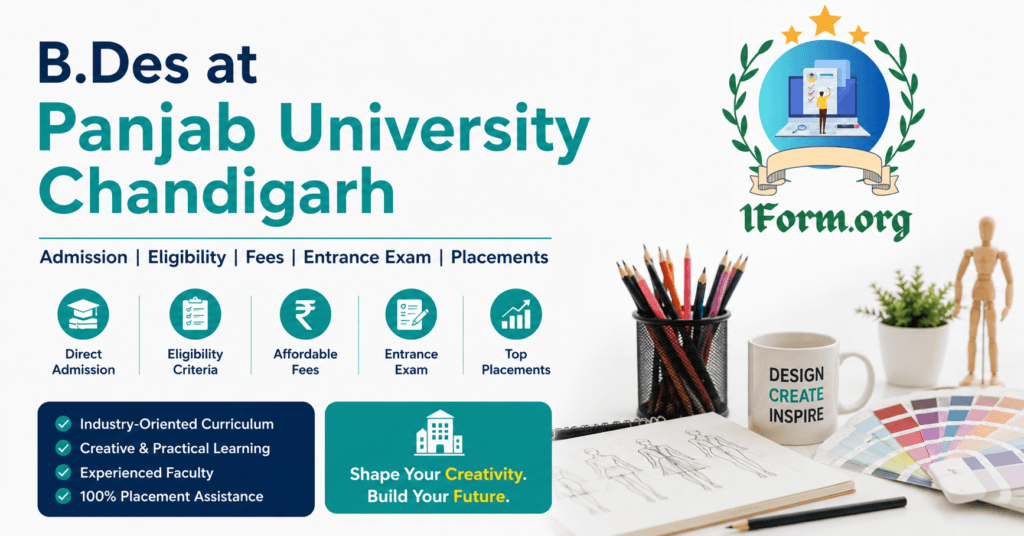
If you are passionate about creativity, innovation, product design, visual communication, or digital media, pursuing a Bachelor of Design (B.Des) at Panjab University Chandigarh can be an excellent career choice. Panjab University is one of India’s most prestigious public universities, offering quality education, experienced faculty, modern infrastructure, and excellent career opportunities.
Apply Now-
Why Choose B.Des at Panjab University Chandigarh?
Panjab University is recognized for its academic excellence and industry-oriented education. The B.Des program focuses on developing creativity, technical skills, problem-solving abilities, and innovation through practical learning.
Highlights
- One of India’s top public universities
- Experienced faculty members
- Affordable fee structure
- Modern design studios and laboratories
- Industry-focused curriculum
- Internship opportunities
- Excellent higher education options
- Strong alumni network
B.Des at Panjab University Chandigarh Highlights
| Particular | Details |
|---|---|
| Course Name | Bachelor of Design (B.Des) |
| University | Panjab University, Chandigarh |
| Course Level | Undergraduate |
| Duration | 4 Years |
| Admission Process | Entrance Exam + Merit |
| Mode | Full-Time |
| Eligibility | 10+2 from a recognized board |
| Campus | Chandigarh |
| Internship | Available |
| Placement Support | Yes |
About Panjab University Chandigarh
Established in 1882, Panjab University Chandigarh is one of India’s oldest and most respected universities. It has consistently ranked among the leading universities in India due to its academic excellence, research facilities, and highly qualified faculty.
Students from across India choose Panjab University because of its affordable education, vibrant campus life, and excellent placement opportunities.
B.Des Admission 2026 at Panjab University
Admission to the B.Des program is generally based on the university’s prescribed admission process, which may include an entrance examination, aptitude assessment, portfolio evaluation (if applicable), and merit.
Admission Process
| Step | Details |
|---|---|
| Step 1 | Visit the official admission portal |
| Step 2 | Register online |
| Step 3 | Fill the application form |
| Step 4 | Upload required documents |
| Step 5 | Pay application fee |
| Step 6 | Appear for entrance test (if applicable) |
| Step 7 | Merit list declaration |
| Step 8 | Document verification |
| Step 9 | Fee submission |
B.Des Eligibility Criteria
Candidates applying for B.Des should satisfy the following eligibility conditions.
| Eligibility Criteria | Details |
|---|---|
| Qualification | 10+2 from a recognized board |
| Minimum Marks | Generally 50% aggregate (subject to university norms) |
| Stream | Any Stream (Arts, Science or Commerce) |
| Age Limit | As per university rules |
B.Des Course Duration
The Bachelor of Design program is spread across 4 years, divided into 8 semesters.
Students gain practical exposure through:
- Design Studios
- Workshops
- Live Projects
- Design Thinking
- Industrial Visits
- Portfolio Development
B.Des Specialization Areas
Students develop expertise in multiple design disciplines.
| Major Learning Areas |
|---|
| Product Design |
| Graphic Design |
| Communication Design |
| Visual Design |
| User Experience (UX) |
| User Interface (UI) |
| Illustration |
| Design Research |
| Packaging Design |
| Branding |
B.Des Course Subjects
The curriculum combines theoretical knowledge with practical studio work.
| Semester Subjects |
|---|
| Design Fundamentals |
| Drawing Techniques |
| Design Process |
| Visual Communication |
| Typography |
| Color Theory |
| Design History |
| Computer-Aided Design |
| Photography |
| Illustration |
| Digital Design |
| Product Design |
| User Experience Design |
| Portfolio Development |
| Internship Project |
Skills Required for B.Des Students
Students should possess or develop the following skills:
- Creativity
- Observation skills
- Communication skills
- Design thinking
- Problem-solving ability
- Visualization skills
- Time management
- Teamwork
- Presentation skills
- Computer proficiency
B.Des Fee Structure (Expected)
The exact fee may vary depending on university notifications.
| Fee Component | Approximate Amount |
|---|---|
| Tuition Fee | ₹25,000 – ₹60,000 per year |
| Examination Fee | As per university norms |
| Development Fee | Applicable |
| Hostel Fee | Extra (if opted) |
Documents Required
Students should keep the following documents ready during admission.
| Required Documents |
|---|
| Class 10 Marksheet |
| Class 12 Marksheet |
| Passport-size Photographs |
| Aadhaar Card |
| Category Certificate (if applicable) |
| Migration Certificate |
| Character Certificate |
| Entrance Scorecard (if applicable) |
Placement Opportunities
Although design placements depend heavily on creativity and portfolio quality, Panjab University provides placement assistance through its placement cell.
Popular Recruiters
| Company |
|---|
| TCS |
| Infosys |
| Accenture |
| Wipro |
| Cognizant |
| Deloitte |
| Design Studios |
| Advertising Agencies |
| Startups |
| Media Companies |
Average Salary After B.Des
| Experience | Average Salary |
|---|---|
| Freshers | ₹3 – ₹6 LPA |
| Mid-Level | ₹6 – ₹10 LPA |
| Experienced Designers | ₹10 – ₹20 LPA+ |
Apply Now-
Career Opportunities After B.Des
Graduates can build successful careers in multiple industries.
- Graphic Designer
- UI Designer
- UX Designer
- Product Designer
- Fashion Designer
- Interior Designer
- Visual Designer
- Illustrator
- Motion Graphics Designer
- Brand Designer
- Art Director
- Packaging Designer
- Game Designer
- Creative Consultant
- Entrepreneur
Higher Education Options
After completing B.Des, students can pursue:
- M.Des
- MBA
- MFA
- UX/UI Certification
- Animation Courses
- Digital Marketing
- Product Management
- International Design Programs
Advantages of Studying B.Des at Panjab University
- Affordable education
- Strong academic reputation
- Practical learning approach
- Experienced faculty
- Excellent campus facilities
- Industry exposure
- Internship opportunities
- Diverse career options
- High employability
- Strong alumni network
Preparation Tips for B.Des Admission
- Practice sketching daily.
- Improve observation and visualization skills.
- Build a creative portfolio.
- Study design fundamentals.
- Stay updated with design trends.
- Practice aptitude and logical reasoning.
- Enhance communication and presentation skills.