

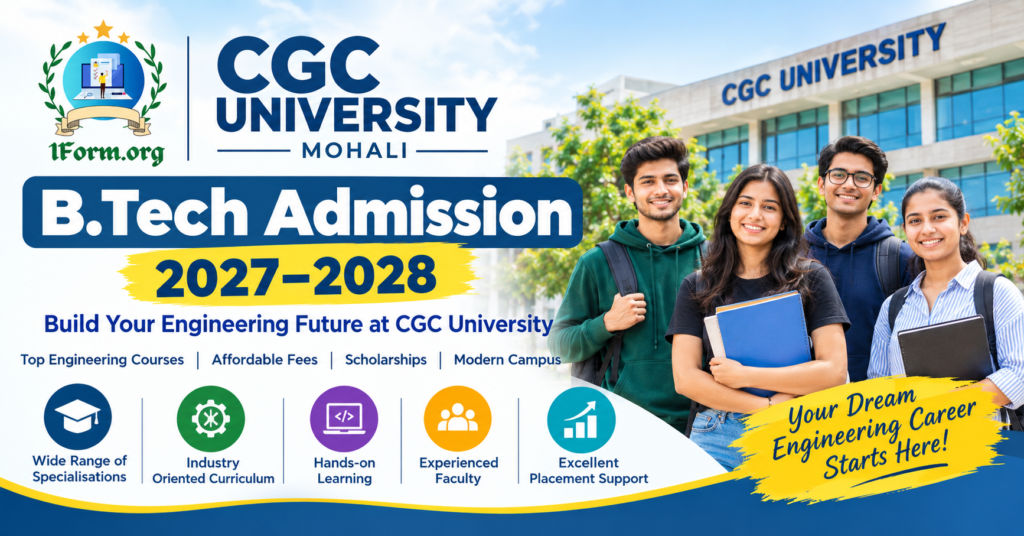
CGC University B.Tech Admission 2027–2028 is an opportunity for students planning to pursue an engineering degree in Mohali, Punjab. The university offers undergraduate engineering programmes in Computer Science and Engineering (CSE), Artificial Intelligence and Machine Learning (AI & ML), Artificial Intelligence and Data Science (AI & DS), Cyber Security, Cloud Computing, Internet of Things (IoT), Robotics and Artificial Intelligence, Civil Engineering, Electronics and Communication Engineering, and Mechanical Engineering.
Students planning to apply for CGC University B.Tech admission should understand the eligibility criteria, course specialisations, semester fees, entrance examination requirements, scholarships and selection procedure before submitting their applications.
CGC University B.Tech Admission 2027–2028: Overview
| Particulars | Details |
|---|---|
| University | CGC University, Mohali |
| Course | Bachelor of Technology (B.Tech) |
| Admission session | 2027–2028 |
| Course level | Undergraduate |
| Standard duration | 4 years |
| Academic structure | Usually 8 semesters |
| Popular specialisation | Computer Science and Engineering |
| Other specialisations | AI & ML, AI & DS, Cyber Security, IoT, Cloud Computing and more |
| Basic eligibility | Class 12 with prescribed subjects and minimum marks |
| Minimum marks reference | Generally 45%; 40% for candidates in applicable reserved categories, subject to current rules |
| Admission process | Application, eligibility verification and applicable selection requirements |
| Entrance and scholarship test | CGCUET, subject to the 2027–2028 admission policy |
| Semester fee reference | Approximately ₹95,000–₹1,15,000 for listed programmes, based on the 2026–2027 schedule |
| Scholarships | Subject to eligibility and the applicable scholarship policy |
| Admission dates | To be confirmed for 2027–2028 |
CGC University B.Tech Courses and Specialisations 2027–2028
Students can choose an engineering specialisation based on their interests, academic strengths and career plans. Computer-related branches may suit students interested in programming and emerging technologies, while core engineering branches offer pathways into infrastructure, electronics, manufacturing and related technical fields.
B.Tech specialisations at CGC University
| B.Tech specialisation | Main areas of study | Potential career paths |
|---|---|---|
| Computer Science and Engineering | Programming, algorithms, databases and software engineering | Software developer, systems analyst |
| CSE – Artificial Intelligence and Machine Learning | Intelligent systems, machine learning and AI applications | AI engineer, ML engineer |
| CSE – Artificial Intelligence and Data Science | Data analysis, statistics and intelligent computing | Data analyst, data engineer |
| CSE – Cyber Security | Network security, digital protection and security testing | Security analyst, cybersecurity specialist |
| CSE – Cloud Computing | Cloud infrastructure, virtualisation and distributed systems | Cloud engineer, cloud support specialist |
| CSE – Internet of Things | Connected devices, sensors and embedded systems | IoT developer, embedded systems engineer |
| CSE – Blockchain Technology | Distributed ledgers, cryptography and blockchain applications | Blockchain developer |
| CSE – Robotics and Artificial Intelligence | Robotics, automation and intelligent systems | Robotics engineer, automation specialist |
| Electronics and Communication Engineering | Electronic circuits, communications and embedded technologies | Electronics engineer, communications engineer |
| Civil Engineering | Structures, construction and infrastructure | Civil engineer, site engineer |
| Mechanical Engineering | Manufacturing, mechanics and machine design | Mechanical engineer, production engineer |
Apply now :-
CGC University B.Tech Fees 2027–2028
The fee structure is an important factor when comparing engineering colleges. Tuition varies according to the selected branch and specialisation.
The following table uses the university’s published 2026–2027 fee schedule as a planning reference. These figures are not confirmed 2027–2028 fees.
| B.Tech course | Published semester fee reference | Estimated tuition for 8 semesters |
|---|---|---|
| B.Tech Computer Science and Engineering | ₹1,05,000 | ₹8,40,000 |
| B.Tech CSE – Internet of Things | ₹1,05,000 | ₹8,40,000 |
| B.Tech CSE – Artificial Intelligence and Data Science | ₹1,15,000 | ₹9,20,000 |
| B.Tech CSE – Artificial Intelligence and Machine Learning | ₹1,15,000 | ₹9,20,000 |
| B.Tech CSE – Blockchain Technology | ₹1,05,000 | ₹8,40,000 |
| B.Tech CSE – Robotics and Artificial Intelligence | ₹1,05,000 | ₹8,40,000 |
| B.Tech CSE – Cloud Computing | ₹1,05,000 | ₹8,40,000 |
| B.Tech CSE – Cyber Security | ₹1,05,000 | ₹8,40,000 |
| B.Tech Electronics and Communication Engineering | ₹95,000 | ₹7,60,000 |
| B.Tech Civil Engineering | ₹95,000 | ₹7,60,000 |
| B.Tech Mechanical Engineering | ₹95,000 | ₹7,60,000 |
Estimated tuition is calculated by multiplying the listed semester fee by eight. It excludes additional charges and assumes the same fee for every semester. Actual programme costs may change.
Additional expenses to consider
The complete cost of studying B.Tech may include:
- Admission and registration charges
- Refundable security deposit, if applicable
- Examination and university charges
- Hostel accommodation and mess expenses
- Transport charges
- Books, laboratory materials and other academic expenses
- Uniform or other programme-specific charges
Students should request the complete fee schedule before confirming admission.
CGC University B.Tech Eligibility Criteria 2027–2028
Candidates should check the eligibility criteria for their selected engineering branch before submitting an application.
Eligibility after Class 12
The published B.Tech eligibility criteria specify that candidates should have passed Class 12 from a recognised board and meet the required subject and marks conditions.
The published eligibility reference includes:
- A minimum of 45% marks for general-category candidates.
- A minimum of 40% marks for candidates belonging to applicable reserved categories.
- Relevant qualifying subjects as prescribed for the programme.
Accepted subjects listed in the published eligibility information include Physics, Mathematics, Chemistry, Computer Science, Electronics, Information Technology, Biology, Informatics Practices, Biotechnology, technical vocational subjects, Agriculture, Engineering Graphics, Business Studies and Entrepreneurship, subject to the applicable course requirements.
Because engineering eligibility can depend on current regulations and the selected branch, candidates should verify the precise subject combination and marks calculation for 2027–2028.
Eligibility through a diploma qualification
Candidates who have completed a recognised three-year diploma in an eligible engineering or technology discipline may be considered for lateral-entry admission, subject to the university’s rules and seat availability.
The published eligibility reference includes a minimum of 45% marks, or 40% for applicable reserved categories, for eligible diploma applicants.
Certain other recognised qualifications may also be considered under the applicable admission policy.
B.Tech lateral-entry admission
Lateral entry is intended for eligible diploma holders who wish to enter an advanced stage of an engineering degree rather than begin from the first year.
| Particulars | Details |
|---|---|
| Entry route | Lateral entry, subject to eligibility |
| Typical qualifying qualification | Recognised engineering diploma |
| Minimum marks reference | 45%, or 40% for applicable reserved categories |
| Admission year | 2027–2028 |
| Seat availability | Subject to programme capacity and university rules |
| Final selection | As prescribed in the admission policy |
Students should check which branches offer lateral entry and whether additional bridge courses or other conditions apply.
CGC University B.Tech Admission Process 2027–2028
Candidates should follow the university’s prescribed application and selection procedure. The precise process and deadlines for 2027–2028 will depend on the official admission notification.
Step 1: Choose a B.Tech specialisation
Review the available engineering programmes and select a branch based on your interests, Class 12 subjects and career goals.
Compare CSE, AI & ML, AI & DS, Cyber Security, Cloud Computing, IoT, Civil Engineering, Mechanical Engineering and Electronics and Communication Engineering before making a decision.
Step 2: Check eligibility
Confirm that you satisfy the required academic marks, subject combination and other programme-specific conditions.
Students applying through lateral entry should separately check the diploma eligibility requirements.
Step 3: Complete the application or CGCUET registration
Follow the university’s designated application process. If CGCUET or another test is required for your programme, complete the relevant registration and examination formalities.
The university’s published 2026–2027 instructions describe an online CGCUET registration process involving account creation, dashboard login, test-slot selection and payment. The 2027–2028 procedure and fee should be confirmed when the new notification is released.
Step 4: Submit academic and personal details
Enter the required information accurately, including:
- Candidate’s name and contact details
- Date of birth
- Class 10 academic information
- Class 12 marks and subjects
- Diploma information, if applying through lateral entry
- Preferred engineering course
- Entrance-test details, where applicable
Step 5: Upload the required documents
Submit the documents requested in the application portal. Ensure that scans are clear and the information matches your original certificates.
Step 6: Complete the applicable selection process
Candidates should participate in the entrance test, submit accepted examination scores, or complete other selection requirements where applicable.
Do not assume that the same examination rules apply to every branch or admission route.
Step 7: Check the admission offer
Review the admission decision, selected programme, fee details and document-verification instructions.
Meeting the minimum eligibility requirements does not automatically guarantee a seat.
Step 8: Verify documents and pay fees
Submit original documents or verified copies as instructed. Pay the prescribed admission fee within the deadline and keep the receipt.
Step 9: Complete enrolment
Follow the university’s instructions for registration, orientation, academic schedules and any separate hostel or transport application.
CGCUET 2027 for B.Tech Admission
CGCUET is the university’s entrance-cum-scholarship test. It is relevant to students exploring admission and scholarship opportunities at CGC University, Mohali.
The university’s published 2026–2027 registration instructions list a ₹1,000 registration fee, including the test fee and prospectus. This amount should not be treated as the confirmed registration fee for 2027–2028.
CGCUET information to check
| Particulars | Details |
|---|---|
| Examination | CGCUET |
| Purpose | Entrance and scholarship assessment, according to the applicable policy |
| Registration | As prescribed by the university |
| Test date and slot | To be announced for 2027–2028 |
| Registration fee | To be confirmed for 2027–2028 |
| Syllabus and pattern | Check the current examination instructions |
| Scholarship benefits | Subject to eligibility and the applicable scheme |
CGC University B.Tech Scholarships 2027–2028
Scholarships can help eligible engineering students reduce their tuition expenses. CGC University publishes scholarship opportunities based on academic performance and applicable entrance-examination criteria.
The university’s published 2026–2027 merit scholarship information includes B.Tech awards based on Class 12 Physics, Chemistry and Mathematics marks or JEE rank.
Published 2026–2027 merit scholarship reference for B.Tech
| PCM marks / JEE rank category | Published tuition scholarship reference |
|---|---|
| PCM 95% or above / JEE rank 1–50,000 | 100% |
| PCM 90% to below 95% / JEE rank 50,001–80,000 | 90% |
| PCM 80% to below 90% / JEE rank 80,001–1,00,000 | 75% |
| PCM 70% to below 80% / JEE rank 1,00,001–1,50,000 | 50% |
| PCM 65% to below 70% / JEE rank 1,50,001–1,75,000 | 25% |
These are published 2026–2027 reference criteria, not a guarantee of scholarship benefits for 2027–2028. Candidates must confirm the latest thresholds, applicable conditions, seat or scheme limitations and renewal rules.
How to check scholarship eligibility
- Review the scholarship policy for the intended admission year.
- Check whether eligibility is based on PCM marks, JEE rank, CGCUET or another recognised criterion.
- Prepare the relevant marksheets and scorecards.
- Confirm the scholarship percentage and whether it applies to tuition only.
- Check renewal requirements for subsequent semesters.
- Obtain confirmation of the final payable fee before payment.
A scholarship advertised as covering up to 100% of tuition does not necessarily cover hostel, mess, examination or other charges.
Documents Required for CGC University B.Tech Admission
Prepare the documents required for your admission route.
| Document | Purpose |
|---|---|
| Class 10 marksheet or certificate | Academic record and date-of-birth verification |
| Class 12 marksheet or certificate | Eligibility verification |
| JEE scorecard, if applicable | Entrance-based admission or scholarship consideration |
| CGCUET details, if applicable | Entrance and scholarship process |
| Diploma marksheets and certificate | Lateral-entry eligibility |
| Identity proof | Personal verification |
| Recent photographs | Application and student records |
| Transfer certificate | Where required |
| Migration certificate | Where required |
| Category certificate | If claiming an applicable reserved-category benefit |
| Scholarship supporting documents | Scholarship assessment |
The university may request additional documents during verification. Candidates awaiting final results should confirm whether provisional applications are permitted.
Apply now :-
B.Tech Admission Dates 2027–2028
The official dates for the 2027–2028 session should be checked when the university releases its admission calendar.
| Admission event | Status |
|---|---|
| Admission notification | To be announced |
| Online application opening | To be announced |
| CGCUET registration dates | To be announced |
| Entrance-test dates and slots | To be announced |
| Application deadline | To be announced |
| Admission offer or selection notification | As announced |
| Document verification | As instructed in the offer |
| Fee payment deadline | As instructed in the offer |
| Academic session commencement | To be announced |
Students should prepare in advance rather than rely on unconfirmed dates published by third-party websites.
Why Choose a B.Tech Specialisation at CGC University?
Choosing an engineering branch requires careful consideration of course content, practical learning and career goals.
Computer Science and Engineering
CSE may suit students interested in programming, software development, databases, operating systems and computer networks. Career options include software engineering, application development and systems analysis.
Artificial Intelligence and Machine Learning
AI and ML programmes focus on intelligent systems, data-driven models and machine learning techniques. Students can explore AI development, machine learning engineering and related technical roles.
Artificial Intelligence and Data Science
This specialisation combines computing, data analysis, statistics and machine learning. It can suit students interested in analytics, data engineering and data-focused software development.
Cyber Security
Cybersecurity programmes focus on protecting networks, systems and information. Possible career paths include security analysis, security testing and information protection.
Cloud Computing
Cloud computing covers distributed infrastructure, virtualisation and cloud-based applications. Graduates may explore cloud operations, cloud support and infrastructure engineering.
Civil Engineering
Civil engineering focuses on construction, structural systems and infrastructure. Career opportunities may include site engineering, construction management and design support, depending on qualifications and experience.
Mechanical Engineering
Mechanical engineering covers manufacturing, mechanics, machine design and industrial processes. Graduates may explore production, maintenance, design and manufacturing roles.
Electronics and Communication Engineering
ECE includes electronic systems, communication technologies and embedded systems. Career paths may include electronics design, communications engineering and technical support.
CGC University B.Tech Placements and Career Opportunities
Placement opportunities depend on the student’s specialisation, technical skills, internships, academic performance and the requirements of employers.
Students evaluating CGC University should review recent placement information for their specific engineering programme rather than relying only on university-wide figures.
Before admission, consider asking about:
- Recent B.Tech placement reports
- Number of eligible students and students placed
- Median salary and average salary, where published
- Highest package and the year it was recorded
- Companies recruiting from the selected branch
- Internship and industry-project opportunities
- Placement eligibility criteria
- Technical training and career support
Career opportunities after B.Tech
| Specialisation | Potential career roles |
|---|---|
| CSE | Software developer, systems analyst, application engineer |
| AI & ML | AI engineer, machine learning engineer |
| AI & DS | Data analyst, data engineer |
| Cyber Security | Security analyst, cybersecurity specialist |
| Cloud Computing | Cloud engineer, cloud operations associate |
| IoT | IoT developer, embedded systems engineer |
| Robotics and AI | Robotics engineer, automation specialist |
| Civil Engineering | Civil engineer, site engineer |
| Mechanical Engineering | Mechanical engineer, production engineer |
| Electronics and Communication | Electronics engineer, communications engineer |
These are possible career paths, not guaranteed job placements. Actual opportunities vary by employer and individual qualifications.
CGC University B.Tech Admission: Important Tips for Applicants
- Start researching engineering branches before applications open.
- Check the official eligibility criteria for your preferred specialisation.
- Compare semester tuition and total programme expenses.
- Keep Class 10 and Class 12 documents ready.
- Check whether CGCUET, JEE or another selection route applies.
- Review the current scholarship policy before calculating the payable fee.
- Verify hostel and transport expenses separately.
- Read the refund and cancellation policy before paying.
- Keep copies of your application, scorecards and fee receipts.
- Confirm the admission offer before making non-refundable commitments.