
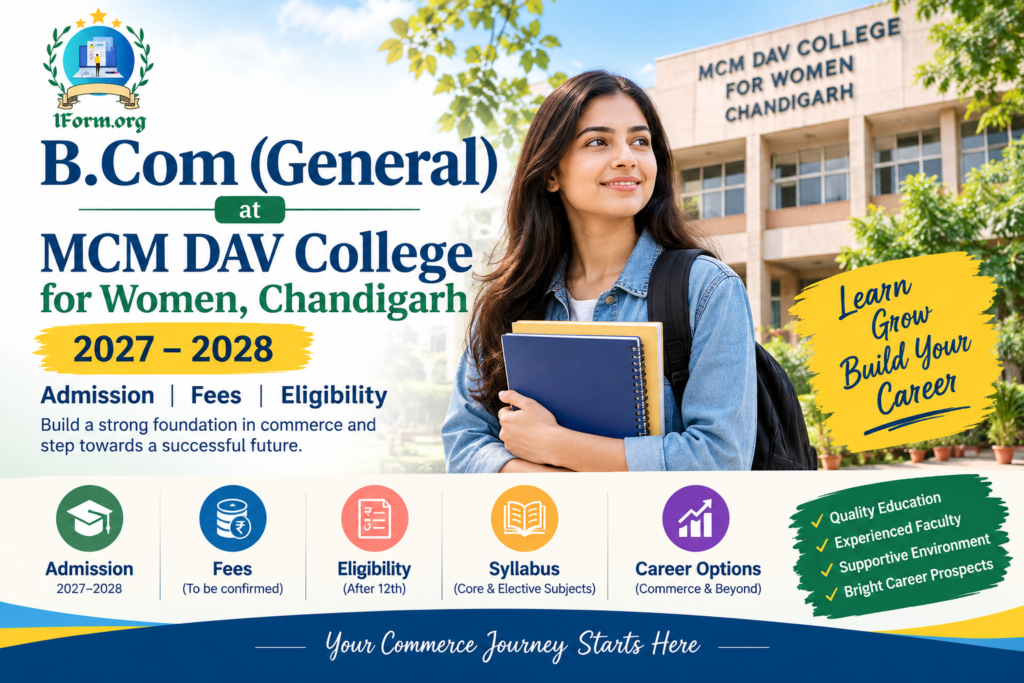
B.Com (General) at Mehr Chand Mahajan DAV College for Women, Chandigarh, is an undergraduate programme for students who want to build a foundation in commerce, accounting, business management, economics and financial systems. The course is suitable for students planning careers in banking, accounting, taxation, finance, business operations and related fields.
Students searching for B.Com admission 2027–2028 in Chandigarh, MCM DAV College B.Com fees, B.Com eligibility after 12th, B.Com admission process and career options after B.Com can use this guide to understand the course and prepare for admission.
MCM DAV College for Women is located in Chandigarh and is affiliated with Panjab University. The B.Com programme generally takes three years under the traditional structure, while the applicable undergraduate framework and duration should be checked in the college’s current prospectus. Admission to B.Com is conducted through the prescribed centralised admission process, subject to the rules for the relevant academic session.
Apply now :-
B.Com (General) at MCM DAV College, Course Highlights
| Particulars | Details |
|---|---|
| College Name | Mehr Chand Mahajan DAV College for Women |
| Location | Chandigarh |
| Course Name | Bachelor of Commerce (B.Com) |
| Course Type | Undergraduate degree |
| Academic Stream | Commerce |
| Course Duration | Generally 3 years under the traditional structure |
| Affiliation | Panjab University, Chandigarh |
| Eligibility | 10+2 or equivalent, subject to university rules |
| Admission Process | Centralised admission and merit-based selection, as applicable |
| Academic Session | 2027–2028 |
| Main Subjects | Accounting, business law, economics, taxation and finance |
| Career Opportunities | Accounting, banking, finance, taxation, business and management |
Why Choose B.Com at MCM DAV College for Women, Chandigarh?
B.Com is a useful option for students who want to understand how businesses operate and how financial decisions are made. It provides a foundation in commercial activities, accounting principles and business practices.
Students may consider MCM DAV College for the following reasons:
- Undergraduate education in commerce and business-related subjects.
- Opportunities to develop financial literacy and analytical skills.
- A foundation for professional courses such as CA, CMA and other finance-related qualifications.
- Preparation for postgraduate study, including M.Com and MBA.
- Career pathways in accounting, banking, taxation, finance and business administration.
- An opportunity to explore internships and practical learning alongside academic study.
Students should review the course structure, college facilities, total fees and admission requirements before making their final decision.
B.Com Eligibility Criteria 2027–2028
Students seeking B.Com admission at MCM DAV College for Women must meet the eligibility conditions prescribed by Panjab University and the applicable Chandigarh admission guidelines.
A recognised Class 12 or equivalent qualification is generally required. The precise subject combination and minimum marks depend on the university’s current rules for B.Com.
| Eligibility Factor | General Requirement |
|---|---|
| Educational Qualification | Passed Class 12 or equivalent from a recognised board |
| Stream | Commerce students may have relevant subject preparation; eligibility for other streams depends on current rules |
| English | Subject requirements must be checked in the applicable regulations |
| Minimum Marks | As prescribed by Panjab University for the admission session |
| Recognised Board | CBSE, PSEB, ISC or another recognised board, subject to equivalence rules |
| Reservation Benefits | As per the applicable Chandigarh Administration and university policy |
| Final-Year Applicants | Must meet the qualifying requirements by the prescribed deadline |
Important: Do not assume that all students need the same percentage or that every subject combination is accepted. Applicants should check the official eligibility criteria for the 2027–2028 session.
B.Com Admission Process at MCM DAV College 2027–2028
B.Com admission is generally part of Chandigarh’s centralised undergraduate admission process. Students should follow the admission portal and instructions specified for the relevant session.
| Step | Admission Activity |
|---|---|
| Step 1 | Read the B.Com admission guidelines for 2027–2028 |
| Step 2 | Check eligibility and the required Class 12 subjects |
| Step 3 | Register on the prescribed centralised admission portal |
| Step 4 | Complete the application form with accurate academic details |
| Step 5 | Upload the required documents |
| Step 6 | Submit the application and pay the prescribed fee |
| Step 7 | Check merit lists, seat allotment or counselling updates |
| Step 8 | Complete the admission formalities within the deadline |
| Step 9 | Pay the college fee to confirm admission |
Applicants should regularly check admission announcements because the application schedule, counselling rounds and document requirements may change each year.
B.Com Admission Dates 2027–2028
The confirmed admission dates for the 2027–2028 session should be taken from the applicable Chandigarh centralised admission notification.
| Admission Event | Expected Status |
|---|---|
| Admission Notification | To be announced |
| Online Registration | To be announced |
| Application Deadline | To be announced |
| Merit List or Seat Allotment | As per the admission schedule |
| Counselling Rounds | As notified |
| Document Verification | As prescribed |
| Fee Payment Deadline | As stated in the allotment instructions |
| Classes Begin | According to the academic calendar |
These are expected admission stages, not confirmed dates. Students should avoid relying on unofficial deadlines when planning their applications.
B.Com Fees at MCM DAV College for Women Chandigarh
The total B.Com fee depends on the applicable academic session, tuition charges, university fees, examination fees and other prescribed expenses.
Published third-party listings show different estimates for the total B.Com cost at MCM DAV College. These figures may cover different fee components or academic periods, so they should not be treated as the confirmed 2027–2028 fee.
Approximate B.Com Fee Structure
| Fee Component | Details |
|---|---|
| Tuition Fee | As specified in the current college fee schedule |
| Admission and Registration Charges | As applicable |
| University Charges | As prescribed |
| Examination Fee | May be charged separately |
| Other College Charges | Depends on the current fee rules |
| Hostel and Accommodation | Additional, if applicable |
| Total Course Fee | To be confirmed for 2027–2028 |
Before taking admission, students should check the latest prospectus for the complete fee structure and payment schedule. They should also confirm whether any charges are refundable and whether additional examination or university fees apply.
B.Com (General) Syllabus and Subjects
B.Com generally covers accounting, business organisation, economics, finance, commercial law and taxation. The exact subjects and semester structure depend on the curriculum applicable to the student’s batch.
Common B.Com Subjects
| Subject | What Students Learn |
|---|---|
| Financial Accounting | Recording transactions and preparing financial statements |
| Business Economics | Economic concepts and their application to business decisions |
| Business Law | Legal principles relevant to commercial activities |
| Corporate Accounting | Accounting for companies and corporate transactions |
| Cost Accounting | Analysing costs and supporting financial control |
| Business Management | Organising resources and managing business operations |
| Business Mathematics and Statistics | Quantitative methods used in commerce |
| Income Tax | Basic principles of income taxation and tax calculations |
| Auditing | Reviewing financial records and internal controls |
| Banking and Finance | Banking operations, financial systems and related concepts |
| Marketing Management | Understanding markets, customers and promotional strategies |
| Entrepreneurship | Business planning, innovation and enterprise development |
Semester-Wise Overview
| Study Stage | Illustrative Areas of Study |
|---|---|
| Semester 1 | Financial accounting, business economics and introductory commerce subjects |
| Semester 2 | Business law, accounting and quantitative subjects |
| Semester 3 | Corporate accounting, management and related commercial subjects |
| Semester 4 | Cost accounting, finance and business-related papers |
| Semester 5 | Advanced commerce subjects, taxation and specialised areas |
| Semester 6 | Auditing, applied business subjects and final-year papers |
This table is an illustrative overview, not a confirmed semester-wise syllabus for the 2027–2028 batch. Students should refer to the current Panjab University curriculum and college instructions for exact paper names.
Skills Developed During B.Com
A B.Com programme can help students develop practical skills useful in business and finance-related work.
- Accounting skills: Understand financial records, transactions and reporting.
- Numerical ability: Work with calculations, percentages and financial information.
- Business communication: Prepare professional documents and communicate with clients or colleagues.
- Analytical thinking: Interpret financial data and evaluate business performance.
- Taxation knowledge: Understand the basics of tax calculations and compliance.
- Problem-solving: Apply commercial concepts to everyday business situations.
- Digital skills: Build familiarity with spreadsheets and accounting software through relevant practical training.
Students can strengthen these skills through internships, computerised accounting courses and professional certifications.
Career Opportunities After B.Com
B.Com graduates can apply for entry-level positions in accounting, banking, finance, administration and business operations. Career growth often depends on work experience, technical skills and additional qualifications.
| Career Option | Main Responsibilities |
|---|---|
| Accounts Assistant | Maintain accounts and assist with financial records |
| Junior Accountant | Record transactions and support financial reporting |
| Banking Associate | Support banking operations and customer services |
| Tax Assistant | Help prepare tax documents and maintain compliance records |
| Audit Assistant | Support audit procedures and financial checks |
| Finance Executive | Assist with budgeting, reporting and finance operations |
| Business Development Executive | Support sales, customer relationships and business growth |
| Payroll Assistant | Help calculate salaries and maintain payroll records |
| Administrative Executive | Support office operations and documentation |
| Accounts Receivable or Payable Executive | Manage payments, invoices and outstanding balances |
Professional Courses After B.Com
Students who want to specialise can consider additional qualifications such as:
| Course or Qualification | Career Focus |
|---|---|
| Chartered Accountancy (CA) | Accounting, auditing, taxation and financial reporting |
| Cost and Management Accountancy (CMA) | Cost management, financial planning and performance analysis |
| Company Secretary (CS) | Corporate law, governance and compliance |
| Master of Commerce (M.Com) | Advanced study in commerce and related subjects |
| Master of Business Administration (MBA) | Management, finance, marketing and business leadership |
| Banking and Finance Certifications | Additional knowledge for relevant financial roles |
| Accounting Software Training | Practical accounting and bookkeeping skills |
| Data Analytics Courses | Business data analysis and reporting |
Admission to these qualifications depends on the requirements of the respective professional body or institution.
Higher Studies After B.Com
Students may continue their education after completing their bachelor’s degree.
| Higher Study Option | Purpose |
|---|---|
| M.Com | Advanced study of commerce, accounting and finance |
| MBA | Management education and business specialisation |
| M.A. Economics | Further study of economic theory and policy, subject to eligibility |
| Professional Accounting Courses | Specialisation in accounting, auditing or taxation |
| Banking Examination Preparation | Preparation for eligible banking recruitment examinations |
| Financial Analysis Courses | Develop financial analysis and investment-related skills |
| Business Analytics | Learn analytical tools used in business decision-making |
Apply now :-
Documents Required for B.Com Admission
The documents required may vary according to the centralised admission guidelines. Commonly requested documents include:
| Document | Purpose |
|---|---|
| Class 10 Certificate or Mark Sheet | Date-of-birth verification |
| Class 12 Mark Sheet | Verification of qualifying marks |
| Class 12 Passing Certificate | Proof of qualification, where required |
| Recent Passport-Size Photograph | Application and admission records |
| Identity Proof | Personal identification |
| Category Certificate | If applicable |
| Chandigarh Schooling or UT Pool Proof | If required to claim the relevant category |
| Migration Certificate | If required |
| Character Certificate | If required |
| Other Prescribed Documents | As listed in the admission notification |
Students should upload clear and accurate documents and keep originals available for verification.