
Introduction
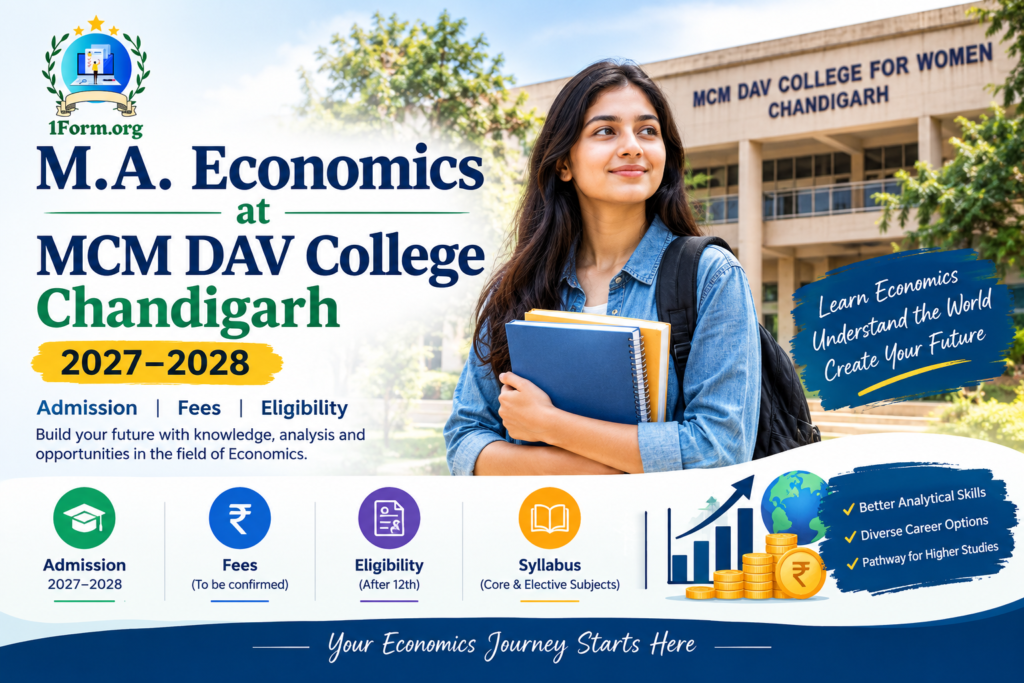
M.A. Economics at Mehr Chand Mahajan DAV College for Women, Chandigarh, is a postgraduate programme for students interested in economic theory, financial systems, public policy, statistical analysis and economic development. The course helps students understand how markets operate, how governments make economic decisions and how economic data can be used to evaluate social and financial issues.
Students searching for MCM DAV College M.A. Economics admission 2027–2028, MA Economics fees, eligibility criteria, syllabus, admission process and career opportunities after MA Economics can use this guide to plan their postgraduate studies.
MCM DAV College for Women is located in Chandigarh and offers postgraduate programmes, including M.A. Economics. The programme is generally two years long and is affiliated with Panjab University, Chandigarh. Applicants should confirm the latest course structure, eligibility requirements and admission schedule for the 2027–2028 academic session before applying.
Apply now :-
M.A. Economics at MCM DAV College Chandigarh: Course Highlights
| Particulars | Details |
|---|---|
| College Name | Mehr Chand Mahajan DAV College for Women |
| Location | Chandigarh |
| Course Name | Master of Arts in Economics |
| Popular Course Keyword | MCM DAV College MA Economics |
| Course Level | Postgraduate |
| Course Duration | Generally 2 years |
| Academic Stream | Arts and Social Sciences |
| Affiliation | Panjab University, Chandigarh |
| Eligibility | Bachelor’s degree meeting the applicable university criteria |
| Admission Process | Merit-based, subject to current admission rules |
| Academic Session | 2027–2028 |
| Main Subjects | Microeconomics, macroeconomics, statistics, international economics and development economics |
| Career Opportunities | Economic research, banking, finance, analytics, policy and teaching |
Why Choose M.A. Economics at MCM DAV College Chandigarh?
M.A. Economics is a suitable option for graduates who want to build a strong foundation in economic analysis and pursue careers related to finance, research, public policy and data interpretation.
Some potential benefits of studying this programme include:
- Understanding economic theories and their practical applications.
- Developing analytical and quantitative problem-solving skills.
- Learning how economic policies affect businesses, households and governments.
- Building a foundation for research and higher studies in economics.
- Exploring career opportunities in banking, financial services, consulting and economic research.
- Preparing for relevant competitive examinations and further academic qualifications.
Students should compare the curriculum, fees, admission criteria and available academic facilities before finalising their college choice.
M.A. Economics Eligibility Criteria 2027–2028
Eligibility for M.A. Economics at MCM DAV College for Women is governed by the applicable Panjab University regulations and the college’s admission guidelines.
The college’s published course information lists eligibility routes that include a B.A. with Honours in Economics, a bachelor’s degree with at least 45% marks in Economics as an elective subject, or a bachelor’s degree in any faculty with at least 50% aggregate marks. Other qualifying routes may apply under the university’s rules.
Eligibility Criteria Table
| Eligibility Factor | General Requirement |
|---|---|
| Educational Qualification | Bachelor’s degree from a recognised university under an accepted eligibility route |
| B.A. Economics Honours | May qualify under the applicable university rules |
| Economics as an Elective | At least 45% marks in Economics under the listed eligibility route |
| Bachelor’s Degree in Another Faculty | At least 50% aggregate marks under the listed route |
| Other Qualifications | Considered if permitted under Panjab University regulations |
| Final-Year Students | Application depends on the current admission instructions |
| Reservation Benefits | As per applicable university and Chandigarh Administration rules |
Important: Meeting the minimum eligibility requirement does not guarantee admission. Final selection depends on the applicable admission rules, merit position, available seats and document verification.
M.A. Economics Admission Process 2027–2028
M.A. Economics is generally listed among the non-centralised postgraduate programmes at DAV College Chandigarh. For such programmes, applicants usually apply through the college’s admission process, subject to the current instructions.
| Step | Admission Activity |
|---|---|
| Step 1 | Check the MCM DAV College M.A. Economics course details |
| Step 2 | Read the 2027–2028 admission notification |
| Step 3 | Verify eligibility and the required documents |
| Step 4 | Complete the admission application form |
| Step 5 | Submit academic details and supporting documents |
| Step 6 | Pay the prescribed application fee, if applicable |
| Step 7 | Check the provisional and final merit lists |
| Step 8 | Complete document verification |
| Step 9 | Pay the prescribed admission fee to confirm the seat |
Applicants should carefully enter their academic marks and personal details. Incorrect information or missing documents may affect the application or admission process.
M.A. Economics Admission Dates 2027–2028
The admission dates for the 2027–2028 session should be confirmed through the college’s new admission notification. The following table provides a planning overview rather than confirmed dates.
| Admission Event | 2027–2028 Status |
|---|---|
| Admission Notification | To be announced |
| Application Form Release | To be announced |
| Last Date to Apply | To be announced |
| Provisional Applicant List | As per the admission schedule |
| Final Applicant or Merit List | To be announced |
| Admission and Document Verification | As notified by the college |
| Fee Payment Deadline | As specified in the selection notice |
| Classes Begin | As per the academic calendar |
Students should prepare their documents in advance and regularly check admission announcements to avoid missing deadlines.
M.A. Economics Fees at MCM DAV College Chandigarh
The total cost of M.A. Economics depends on the applicable tuition charges, university fees, examination fees and other prescribed expenses.
A third-party course listing has previously reported an indicative total fee of approximately ₹62,620 for an M.A. Economics programme associated with Panjab University. However, fee figures can differ by college and admission year, so this amount should not be treated as the confirmed MCM DAV College fee for 2027–2028.
Approximate Fee Structure
| Fee Component | Details |
|---|---|
| Tuition Fees | Confirm from the college’s latest fee schedule |
| University Charges | As prescribed for the academic session |
| Examination Fees | May be charged separately |
| Registration or Other Charges | Applicable as per college rules |
| Hostel and Accommodation | Additional, if applicable |
| Total Course Fees | To be confirmed for 2027–2028 |
Students should calculate the total two-year expense using the latest official fee schedule rather than relying solely on older fee estimates.
M.A. Economics Syllabus at MCM DAV College
The M.A. Economics curriculum is designed to develop knowledge of economic theories, mathematical and statistical techniques, financial systems and development issues. The exact semester-wise syllabus should be checked against the curriculum applicable to the student’s admission batch.
Common M.A. Economics Subjects
| Subject | Key Topics |
|---|---|
| Microeconomics | Consumer behaviour, production, costs and market structures |
| Macroeconomics | National income, inflation, employment and economic growth |
| Quantitative Methods | Mathematical tools used in economic analysis |
| Statistics for Economics | Data analysis, probability and statistical interpretation |
| International Economics | International trade, exchange rates and balance of payments |
| Monetary Economics | Money supply, banking systems and monetary policy |
| Public Economics | Government revenue, expenditure, taxation and fiscal policy |
| Development Economics | Poverty, inequality, growth and economic development |
| Econometrics | Statistical methods for analysing economic relationships |
| Indian Economic Issues | India’s economic structure, policies and development challenges |
Semester-Wise Course Overview
| Semester | Illustrative Areas of Study |
|---|---|
| Semester 1 | Microeconomics, macroeconomics, quantitative methods and international economics |
| Semester 2 | Further economic theory, statistics and selected economic applications |
| Semester 3 | Advanced economic analysis, development economics and specialised papers |
| Semester 4 | Advanced or optional subjects and applied economic analysis |
This table is an indicative overview of common postgraduate economics topics, not a confirmed semester-wise syllabus for every MCM DAV College batch. Students should use the applicable college or Panjab University syllabus for exact paper names and course requirements.
Skills Developed During M.A. Economics
The programme can help students develop a combination of analytical, quantitative and communication skills.
- Economic analysis: Understand market behaviour, economic trends and policy decisions.
- Quantitative reasoning: Interpret numerical information and economic indicators.
- Statistical analysis: Evaluate datasets and identify patterns.
- Research skills: Collect, analyse and present economic information.
- Policy evaluation: Examine the likely effects of government policies.
- Problem-solving: Apply economic concepts to real-world situations.
- Communication: Explain economic findings through reports, presentations and written analysis.
These skills are relevant to research organisations, financial services, consulting firms, public-sector institutions and businesses.
Career Opportunities After M.A. Economics
Graduates can explore opportunities in banking, finance, research, analytics, consulting, government-related work and education. The roles available depend on skills, experience, recruitment criteria and any additional qualifications.
| Career Option | Main Responsibilities |
|---|---|
| Economic Research Assistant | Support economic studies, data collection and research reports |
| Financial Analyst | Evaluate financial information, performance and market trends |
| Data Analyst | Analyse datasets and prepare reports for decision-making |
| Banking Professional | Work in banking operations, analysis or relevant specialist roles |
| Policy Research Assistant | Examine economic policies and their potential effects |
| Market Research Analyst | Study consumer behaviour, industry trends and market conditions |
| Business Analyst | Analyse business performance and support strategic decisions |
| Statistical or Research Assistant | Assist with data processing, interpretation and reporting |
| Economic Consultant | Provide economic analysis and research support |
| Teacher or Academic Researcher | Pursue eligible teaching and research roles with required qualifications |
Government Job Opportunities After M.A. Economics
Students may consider government examinations and recruitment opportunities where their degree meets the prescribed eligibility requirements. Depending on the position, these may include economic research roles, statistical services, banking examinations, public-sector recruitment and other competitive examinations.
Eligibility, age limits, subject requirements and examination patterns vary by recruiting authority. An M.A. Economics degree does not automatically qualify a candidate for every government post.
Higher Studies After M.A. Economics
Students who want to specialise further can consider additional academic and professional qualifications.
| Higher Study Option | Purpose |
|---|---|
| Ph.D. in Economics | Advanced research in economic theory, policy or applied economics |
| UGC NET or SET Preparation | Relevant pathway for eligible academic teaching careers |
| Economics Research Programmes | Develop specialised research and analytical expertise |
| Data Analytics Courses | Strengthen data handling and interpretation skills |
| Financial Analysis Certifications | Build relevant knowledge for finance-related roles |
| Public Policy Programmes | Focus on government policy and development |
| Statistics or Econometrics Training | Develop advanced quantitative skills |
Apply now :-
Documents Required for M.A. Economics Admission
Applicants should prepare the documents specified in the current admission notice. Commonly required documents may include:
| Document | Purpose |
|---|---|
| Class 10 Mark Sheet or Certificate | Date-of-birth verification |
| Class 12 Mark Sheet | Academic record |
| Bachelor’s Degree Certificate | Proof of graduation |
| Graduation Mark Sheets | Verification of eligibility and marks |
| Identity Proof | Personal identification |
| Passport-Size Photographs | Application and admission records |
| Category Certificate | If applicable |
| Migration Certificate | If required |
| Character Certificate | If required |
| Other Prescribed Documents | As stated in the admission notification |
The college may require original documents or digitally uploaded copies at different stages. Students should follow the instructions in the current prospectus.